Preschool Calendar Activities
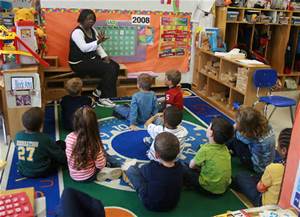
Preschool calendar activities are a useful way to teach days, months, and counting skills.
However, they need not be limited to Circle Time! Preschoolers have such a limited attention span in a large group setting (20 minutes average) and "Calendar Time" can take up 6 of those minutes!
Normally preschool calendar activities take place during morning circle time. Circle time is a time to gather together and learn what will be going on for the rest of the day. Doing the calendar activity at this time fits nicely.
Exposing preschoolers to the days, dates, and months of the year is helpful but not essential. Remember, preschoolers do not tell time in the way that we do. It is fine to discuss these items but realize that most of your children will not break the code of understanding such an abstract concept as time in this manner. Sure, they can memorize it, but won't quite "get it".
Preschool calendar time does not need to be limited to just the days of the week. The math concepts that are introduced with calendar activities are incredible! Sure, they will learn "rote" counting as you point and count each number together...and rote counting is an important step to breaking the math code!
Preschoolers can also learn:
- Rational counting (how many more days)
- One-to-one correspondence
- Matching printed numbers with spoken numbers (number identification)
For calendar time, singing songs are very effective! There are so many songs that the children will enjoy during this time that could make up your entire calendar time in a fun, interactive way!
My all time favorite is Dr. Jean & Friends which has songs for days of the week, months of the year and other fantastic songs!
Preschool Calendar Activity Suggestions
With the introduction of preschool calendar activities comes about math and social concepts. Creating an environment for the children to establish the calendar time routine will allow for daily counting, one-to-one correspondence and matching.
There are so many ways to incorporate calendar activities into your day and into your curriculum!
- Add a calendar to your library! Add either a flannel calendar or a pocket chart calendar for your preschoolers to interact with individually or in smaller groups.
- Add a calendar to your math center! There are many table top calendars out there or that you could make to allow for interaction!
- Add a calendar to your dramatic play area! Add a magnetic easel and add a magnetic calendar for the children to use! This would work with many themes you have in dramatic play including: School; Doctor's Office; Restaurant and more!
  |
Here is a Calendar Time Flip Chart And CD I've used in the classroom. I love this one because it is so mobile! We can use it at Circle Time and then carry it to the library, math table or anywhere else!
|
Daily exploring with the names of months also introduces letters and letter sounds. The children will constantly be exposed to counting and saying the days of the week in order this way. In edition, mark special days for each month such as:
- birthdays
- holidays
- days the school is closed
- field trip days
- special visitor’s day
- seasonal change

If there are any other days that are pertinent to your classroom, feel free to also add them to your calendar! At the preschool age, children are still in the egocentric stage. Introducing them to others’ birthdays and special days will help the children to begin to think outside of their own little world. They can begin to understand the world on a different level.
When children begin learning about different holidays and special milestones, they start slowly learning about history (Veteran’s Day, Fourth of July, President's Day, Martin Luther King Day) and geography (seasonal changes). The younger the children can discover these special days, the sooner they can begin the process of higher learning.
As I stated near the beginning of this article, preschool calendar activities need not be limited to Circle Time! Change it up a bit, get creative and add hands-on calendar fun throughout your classroom!
Go to Preschool Professor's HOME Page




%20and%20%22Calendar%20Time%22%20can%20take%20up%206%20of%20those%20minutes!%20%20Read%20more%20here!)